AVE Clinical Exam Changes from November 2026: The New OSCEs and the Case Log
From the November and December 2026 sittings, the AVE anaesthesia and surgery sections use models instead of live animals, and you need a case log of three anaesthetic and three surgical cases before you enrol. What changed, a filled-in example, and a free template.
The GdayVet Team
21 September 2026
8 min read
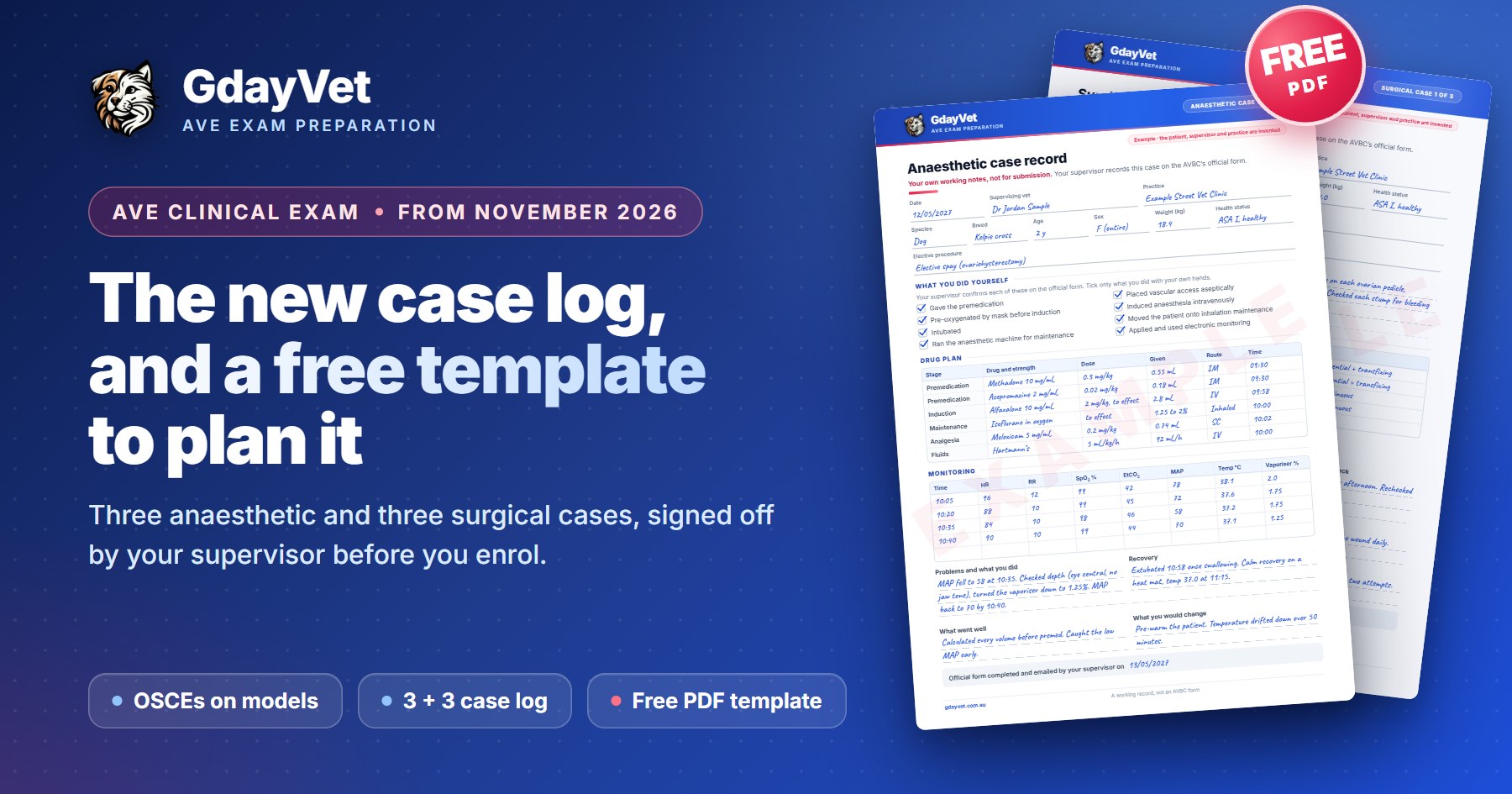
AVE Clinical Exam Changes from November 2026: The New OSCEs and the Case Log
If you are sitting the AVE clinical exam from November 2026 onwards, two things are different from what you may have read before. The anaesthesia and surgery sections are now examined on models, not live animals. And before you can enrol, you need a case log of three anaesthetic and three surgical cases, signed off by a supervising vet.
The AVBC says the new format and the case log "will first apply to all enrolments in the 2026 November and December clinical examination sessions." The other seven sections of the exam are unchanged.
Why the AVBC made the change
The AVBC's notice gives the reason plainly: recent changes to policies on using animals for assessment, both its own and those of the University of Queensland, where the clinical exam is usually held. So the two sections that used a live anaesthetic and a live operation now use models, manikins and written tasks.
The anaesthesia OSCE
An OSCE (objective structured clinical examination) is a set of timed stations. At each one you get a written brief and three minutes to read it, then 20 minutes to complete the tasks.
The AVBC does not say how many anaesthesia stations there are; its wording is "a number of stations". What it does set out are the three areas they are built around, all of them under its Day One Competency 10.
| Area | What you do |
|---|---|
| 1 | Write an anaesthetic plan for a healthy dog having a spay: drugs, doses, dose rates, breathing circuit, oxygen flow and fluids. Be ready to explain your choices. |
| 2 | Show that you can use inhalation anaesthesia equipment safely: prepare the machine and run the safety checks, including a leak test. |
| 3 | Read a multiparameter monitor, tell normal from abnormal values, and respond to the abnormal ones in a systematic way. |
An examiner or observer is at every station. Written tasks are marked after the exam.
The surgery OSCE
Surgery has two stations, again with three minutes of reading time at each.
Station 1 (70 minutes). You spay a canine ovariohysterectomy model. The time includes scrubbing, gowning and gloving, draping the patient, and setting up the instrument table as a sterile field.
Station 2 (45 minutes). Three tasks of 15 minutes each:
- a routine diagnostic technique, such as radiography, a biopsy or a dental examination, and a surgical plan for the case in front of you
- a discharge form for a dog after a spay or neuter, covering home pain relief worked out from a dose table, what to watch for at the wound, and when to come back
- an intra-operative or post-operative complication, where you outline how you would work it up and manage it
There is no cystotomy in the new format, and no live patient.
What stays the same
The exam is still nine sections over five days, usually at the University of Queensland's Gatton campus, and you still need a pass in all nine. The three orals (small animal practice, production animal practice and preventive medicine), equine practice, cattle and sheep clinical skills, the pathology practical, and the handling and physical examination of the cat and dog keep their current format.
The case log
This is the part that needs the most lead time. You cannot put it together in the few weeks after an MCQ result.
What counts
- Three anaesthetic cases: general anaesthetics in stable dogs or cats having an elective procedure, such as a spay.
- Three surgical cases: routine procedures involving a laparotomy. A spay is the most common.
- Dogs and cats only.
Who can supervise
Each case has to be done under an approved supervising veterinarian. Your supervisor has to meet one of two tests:
- they are currently registered and practising in Australia or New Zealand; or
- they hold a qualification on the AVBC Qualifications Generally Recognised list and are registered to practise in the place where the case is done.
Different approved vets can supervise different cases.
Check the list before you book anything. This is the part of the requirement that catches people, so it is worth being blunt. The list is a list of schools and pathways, not a list of countries where good surgery happens. At its 22 December 2025 update it covers veterinary degrees from Australia, New Zealand, Hong Kong SAR, Thailand, Sweden, Switzerland, the United States, Canada, the United Kingdom, Ireland, France, the Netherlands, South Africa, South Korea, Mexico, Grenada and St Kitts and Nevis. Most entries also carry a year range, so the year your supervisor graduated matters as well as where.
No veterinary school in India, Nepal, the Philippines, Pakistan, Sri Lanka, Bangladesh or Egypt appears on it. If you are in one of those countries, a colleague whose only qualification is a local degree cannot sign your case log, however senior or skilled they are.
That does not mean the log has to be built in Australia. It means the supervisor has to be the right person rather than the nearest person. In practice that is usually one of two people:
- a vet who trained at one of the listed schools and has since come home and registered locally, or
- a local vet who came through one of the recognised non-award pathways: ECFVG plus NAVLE, PAVE plus NAVLE, RCVS membership by Statutory Membership Examination, the Canadian NEB Certificate of Qualification, or the AVE itself.
If your supervisor is not registered and practising in Australia or New Zealand, you also need an Approval of Supervisor form accepted before the cases. The form asks you to show that they hold a listed qualification, are registered to practise where the procedures will happen, and have access to appropriate facilities, equipment and drugs. The AVBC strongly encourages you to have that approval in place before you do the cases, and it is easy to see why: six cases signed by someone who does not meet the test are six cases you will be doing again.
The paperwork
Every case goes on the AVBC's official form: one form per case, completed and signed by your supervisor. The form includes the supervisor's email address, and it has to be sent from that address. You will find the forms in the AVBC's Information for AVE Candidates.
The AVBC also asks for its Clinical Skills Checklist as a supporting document when you enrol, so keep that up to date as you go. You can track yours with our clinical skills checklist.
When it is due
The AVBC's notice says the logs must be in before you enrol. Its candidate information goes further: only candidates who have submitted complete case logs with their expression of interest can be considered for a place in a session. Work to that earlier point.
Sending six forms does not mean the log is accepted. The AVE Committee has to find the cases satisfactory, which is one more reason to start early.
How long it lasts
Once accepted, the case logs stay valid until you finish the clinical exam or reach the five-year limit that runs from passing the MCQ.
What a filled-in log looks like
Below is our own working log, filled in for a made-up patient and supervisor. It is not the AVBC form. It is the set of notes you keep so your supervisor can complete the official form quickly and accurately.
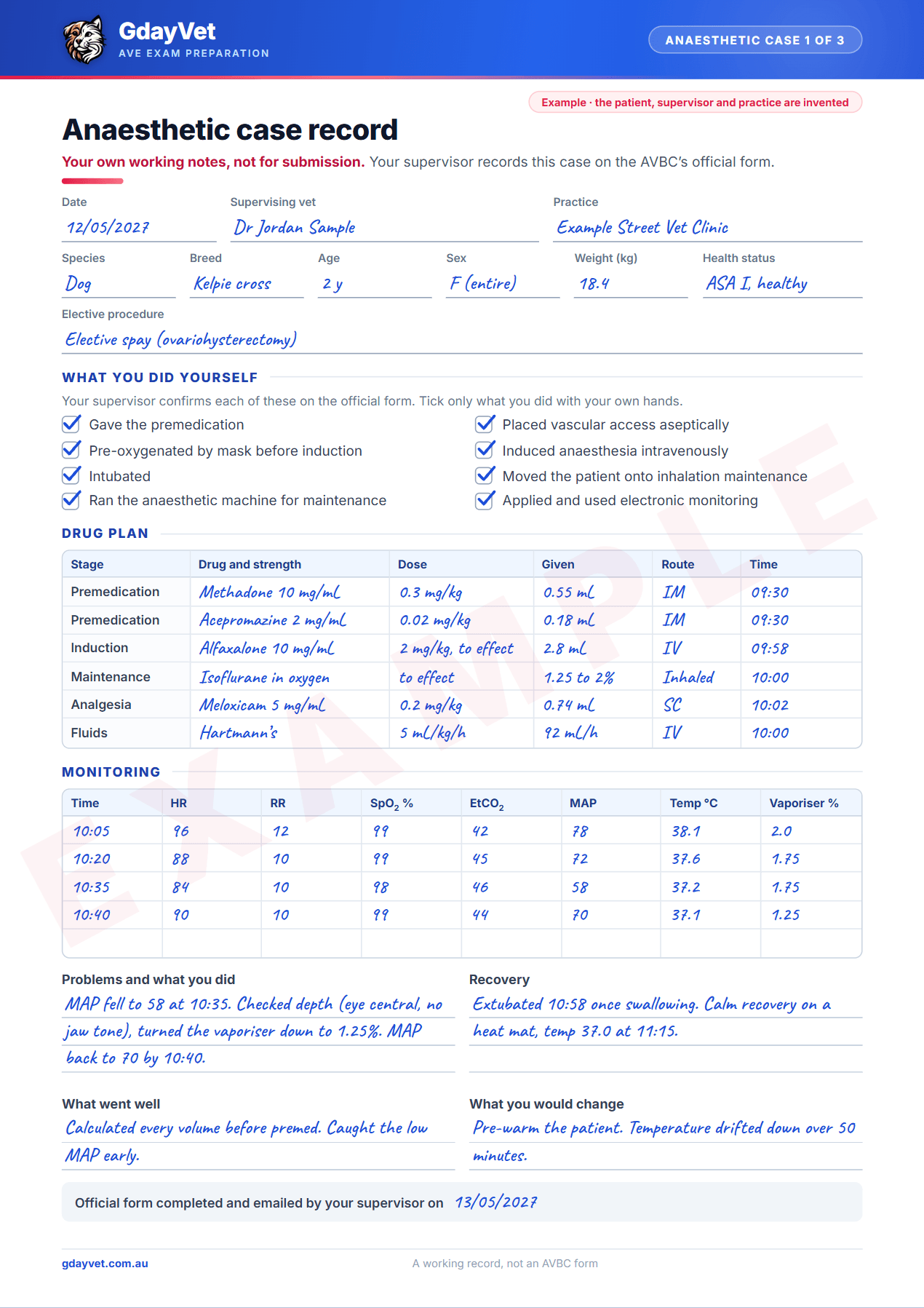
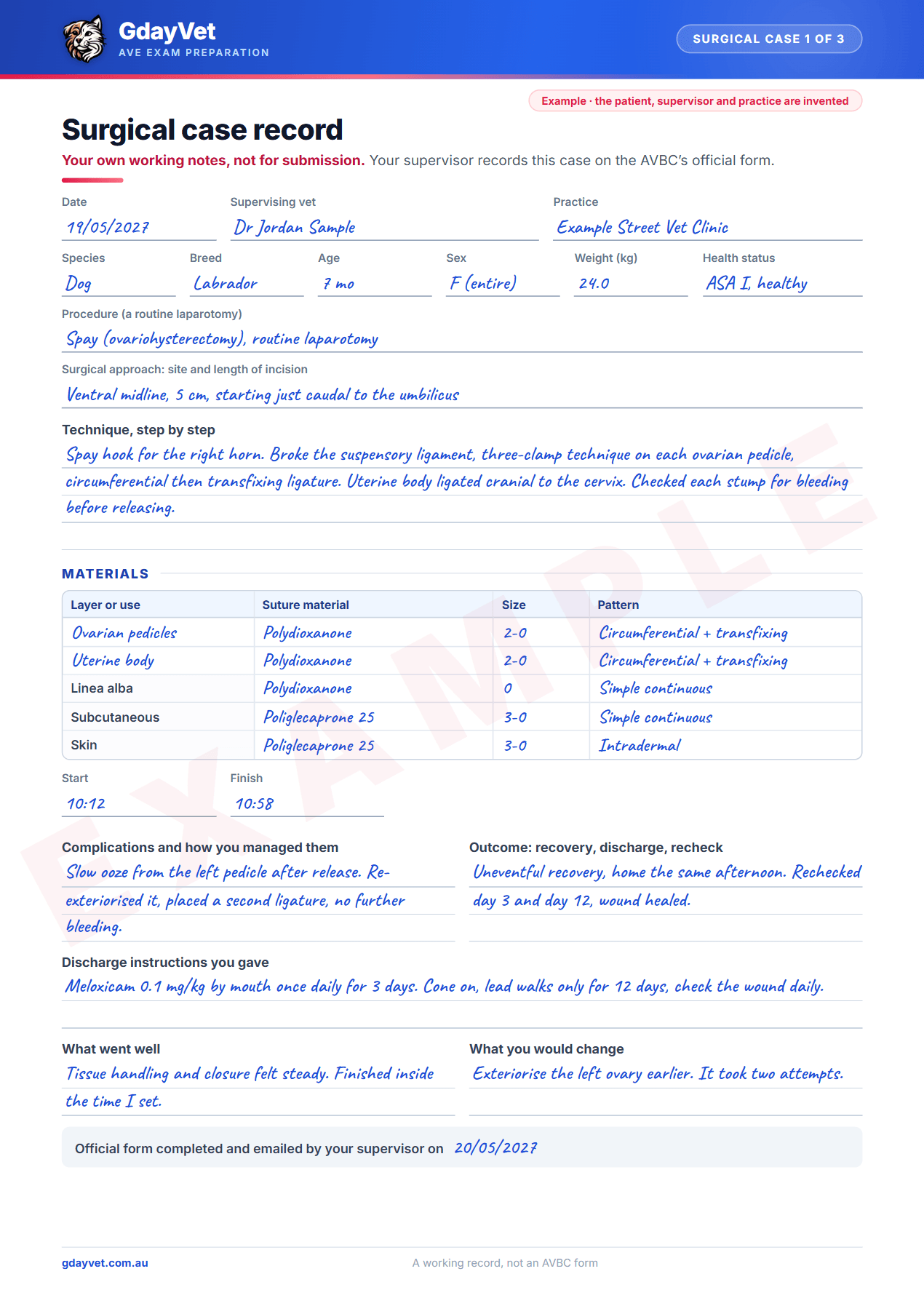
The drug doses and suture choices in the example are ordinary ones for a healthy dog. For real cases, follow your supervisor's protocol.
Download the free template
Download the GdayVet case log template (PDF, 7 pages)
It includes:
- a planner for your supervisors and all six cases, with a checklist to run through before your expression of interest
- three anaesthetic case records: the patient, what you did yourself, the drug plan, monitoring, problems and recovery
- three surgical case records: the approach, technique, suture materials by layer, complications, outcome and discharge
Print it, or write on it with a tablet and stylus. It is free to use and to share with the vets supervising you.
How to prepare for the new format
For the anaesthesia stations, practise dose calculations against the clock, run through a machine check and leak test until you no longer need a checklist, and get used to reading a multiparameter monitor and saying what you would do about each abnormal value.
For surgery, time yourself doing a spay on a model, and write a few discharge forms with pain relief worked out from a dose table. Examiners use proper instrument names, so learn them.
Our AVE Part II course covers all nine sections of the clinical exam, with oral exam practice and written study guides for the practical sections. For the dates that come before any of this, see our 2027 key dates guide.
Based on the AVBC's notice on changes to the clinical exam and its Information for AVE Candidates (May 2026). Check avbc.asn.au for the current forms before you start.
Frequently Asked Questions
Do I have to use the AVBC's official case log forms?
Yes. Each case has to be submitted on the AVBC's own form, one form per case, completed and signed by your supervising vet and sent from the supervisor's email address. A template like ours is only a working log to help you plan the cases and keep notes.
When do the AVE clinical exam changes start?
The AVBC says the OSCE format and the case log requirement first apply to all enrolments in the November and December 2026 clinical exam sessions.
Is there still live surgery in the AVE clinical exam?
No. From the November and December 2026 sessions, the surgery section uses a canine ovariohysterectomy model and written tasks, and the anaesthesia section uses models and manikins.
Can my case log supervisor be outside Australia or New Zealand?
Yes, but not just any vet. They must hold a qualification on the AVBC Qualifications Generally Recognised list and be registered to practise where the cases are done, and you need an Approval of Supervisor form accepted first. That list covers schools in Australia, New Zealand, Hong Kong SAR, Thailand, Sweden, Switzerland, the US, Canada, the UK, Ireland, France, the Netherlands, South Africa, South Korea, Mexico, Grenada and St Kitts and Nevis, plus non-award routes such as ECFVG, PAVE, RCVS Statutory Membership and the AVE. No Indian, Nepali, Filipino, Pakistani, Sri Lankan, Bangladeshi or Egyptian veterinary school is on it, so a colleague holding only a local degree cannot sign your log.
Which cases count towards the AVE case log?
Three general anaesthetics in stable dogs or cats having an elective procedure such as a spay, and three routine surgical procedures involving a laparotomy, most often a spay. Only dogs and cats count.
When do I submit the case log?
Before you enrol. The AVBC only considers candidates who have submitted complete case logs with their expression of interest for a session, so aim for that earlier point. The AVE Committee also has to find the cases satisfactory.
How long does an accepted case log stay valid?
Until you complete the clinical exam or reach the five-year limit that runs from passing the MCQ.
Legal Information & Attribution
Content License: CC-BY-4.0
Attribution:
Based on official information published by the Australasian Veterinary Boards Council (AVBC), accessed 22 September 2026. Check avbc.asn.au for the current requirements, forms and recognised-qualification list before you start.
Sources & References
Changes to the AVE (Final) Clinical Examination
Australasian Veterinary Boards Council — AVBC News
https://avbc.asn.au/news/changes-to-the-ave-final-clinical-examination/
Information for AVE Candidates (May 2026)
Australasian Veterinary Boards Council — AVBC Publications
https://avbc.asn.au/wp-content/uploads/2026/05/AVE-Candidates-Handbook-May2026.pdf
AVBC Qualifications Generally Recognised (updated 22 December 2025)
Australasian Veterinary Boards Council — AVBC Veterinary Education
https://avbc.asn.au/veterinary-education/avbc-qualifications-generally-recognised/
This content is a derivative work based on the sources cited above.
Related Articles

Pakistani Veterinarian's Guide to Australia: Complete 2026 AVE Pathway
The complete 2026 guide for Pakistani DVM graduates seeking veterinary registration in Australia. Fees in ₨ and AUD, AVE pathway, visa subclasses (189, 190, 491, 482 Skills in Demand, 186), CSOL and MLTSSL, English requirements, realistic timeline, and common mistakes to avoid.
11 min read

The AVE MCQ Exam: What I Wish Someone Had Told Me Before I Sat It
Master the Australasian Veterinary Examination (AVE) MCQ format with this comprehensive guide. Learn about the two-paper structure, Computerized Adaptive Testing (CAT), scoring methodology, and expert preparation strategies for international veterinarians.
4 min read